Which roads require the rovinieta
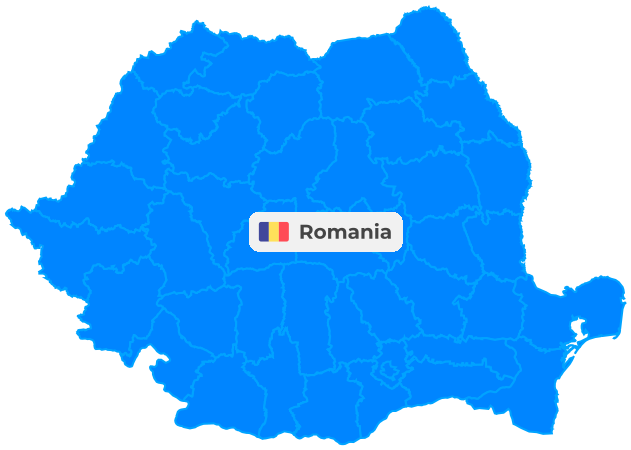
The rovinieta is issued and enforced by CNAIR, the national road infrastructure authority, under Government Ordinance 15/2002. Unlike most European vignette countries, it is not limited to motorways: it covers the entire national road network, meaning motorways (autostrazi, prefixed A) and ordinary national roads (drumuri nationale, prefixed DN), including the national roads that also carry European route numbers.
The main exception is road sections that run through built-up areas (intravilan), between a town's entry and exit signs, where no rovinieta is charged. County and local roads (DJ and DC) are not part of the tolled network at all. Because so much of Romania's inter-city driving happens on DN roads rather than motorways, a rovinieta is needed for far more routes here than in countries where only the motorway network is tolled.
Vehicle categories and validity periods
Vehicles are split into weight- and seat-based categories, from A (cars) and B (goods vehicles up to 3.5 tonnes maximum authorised mass) through several heavier goods and bus categories. Cars and vans are what most foreign drivers need to buy.
For category A cars, the rovinieta comes in five fixed periods: 1 day, 10 days, 30 days, 60 days or 12 months, counted from a start date you choose rather than the purchase date. The 7-day and 90-day periods that appear in some tariff tables belong to the heavier categories, not to cars. A trailer or caravan towed behind a car does not need its own rovinieta; the fee is charged only on the towing vehicle.
From 1 October 2026, CNAIR is introducing TollRo, a distance-based electronic toll for goods vehicles over 3.5 tonnes, replacing their flat-fee rovinieta. Cars and vans up to 3.5 tonnes are unaffected and keep the same rovinieta and validity periods.
Buying and activation
The Romanian rovinieta has been fully electronic for years: it is registered against your licence plate in CNAIR's national database, and no sticker is issued or displayed. You order it with your plate number and vehicle category, and it runs for the period you selected from the start date you chose. For every period longer than a single day you also need the vehicle's VIN (chassis number), which CNAIR requires alongside the plate, so keep the registration document to hand when ordering.
Because the record is plate-based, a mistyped registration number leaves the vehicle uncovered even though payment went through, so double-check the plate before confirming an order. Vignette ID's Flex add-on lets you correct the registered plate on an existing order after purchase, for a fee.
Fines and enforcement
Compliance is checked through SIEGMCR, CNAIR's national rovinieta database, cross-referenced in real time by e-Sigur, an ANPR camera network that also flags speeding and expired insurance. When a camera detects a vehicle without a valid rovinieta, traffic police review the case and issue the penalty notice, posted to the address on the registration certificate for Romanian-registered vehicles.
For cars, the fine for driving without a rovinieta runs from about 500 to 1,000 lei, with substantially higher fines for goods vehicles and buses. Paying within 15 calendar days of the notice typically halves the amount owed, and buying a rovinieta afterwards does not cancel a fine already issued.
Tolls not covered by the rovinieta
Some Danube crossings are charged separately and are not included in the rovinieta. The Fetesti-Cernavoda bridge on the A2 motorway and the Giurgeni-Vadu Oii bridge on DN2A, both common routes to the Black Sea coast, each carry their own per-crossing toll; Fetesti-Cernavoda is collected automatically by ANPR cameras, while Giurgeni-Vadu Oii is currently paid only at the barrier, in cash or by card.
The two road bridges into Bulgaria are also tolled independently of either country's vignette: the Giurgiu-Ruse bridge (Podul Prieteniei) on DN5, where CNAIR runs its own electronic toll platform on the Romanian side, and the Calafat-Vidin bridge on DN56, tolled on the Bulgarian side. Both need a separate payment on top of a valid Romanian rovinieta and, once across, a Bulgarian vignette.