What you get on one connection
Instead of integrating a separate toll authority per country, you connect once and reach official vignette products for cars, vans and motorcycles across Austria, Switzerland, Slovenia, Hungary, Slovakia, Czechia, Romania, Bulgaria and Moldova, plus Austria's Alpine section tolls (Brenner, Tauern, Katschberg, Karawanken, Arlberg, Gleinalm and Bosruck) that sit outside the ordinary vignette.
Every product comes from the national provider, not a third-party markup added silently on top: the catalogue returns the government price and your fee as separate fields, so what you show a customer and what you keep is never a mystery.
Three ways to integrate
Pick the integration that matches how much control you need and how much engineering time you have.
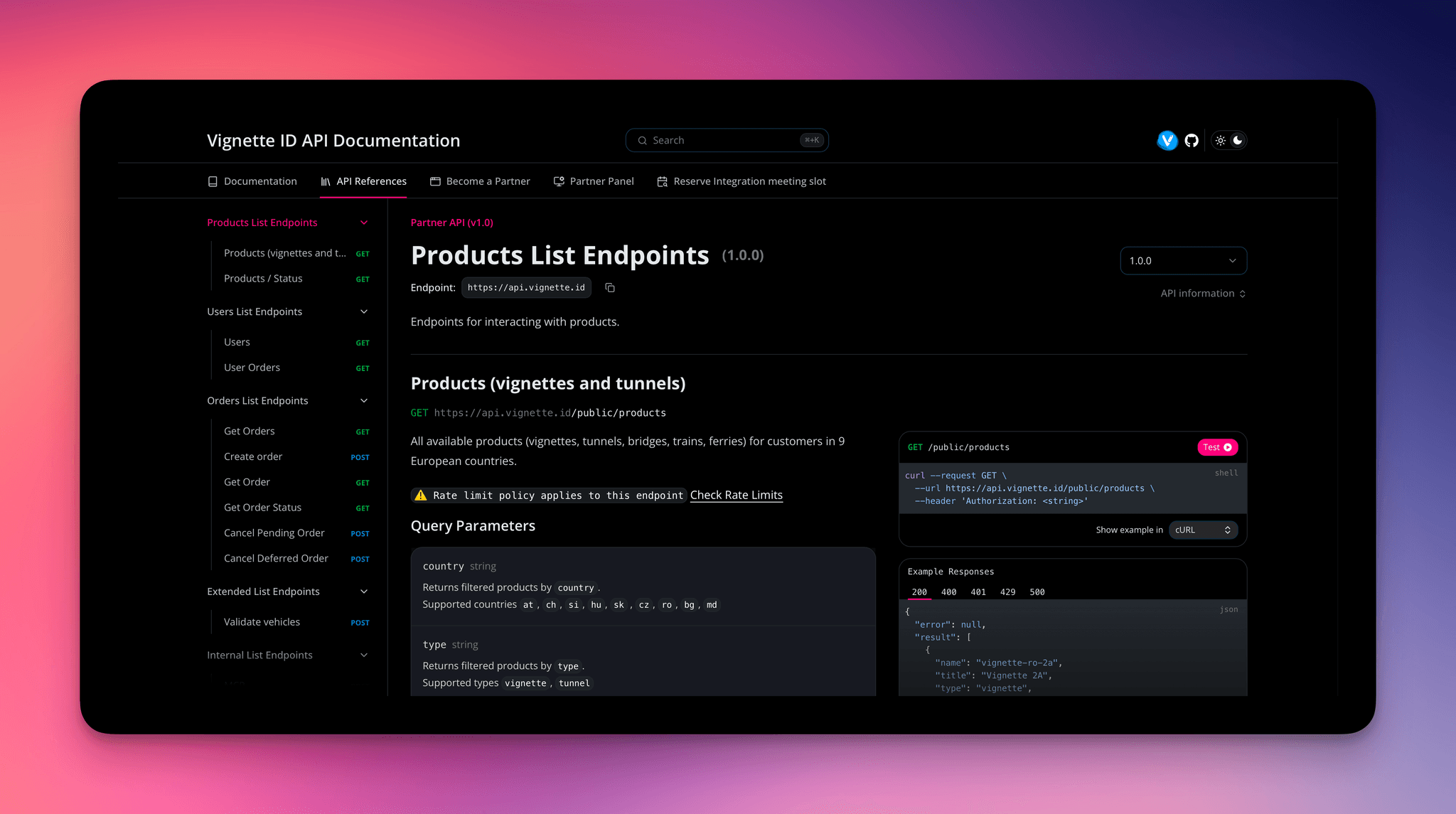
- REST API: full control over the catalogue, checkout and order lifecycle inside your own product and currency. Suits developers building a custom checkout, booking flow or backend automation.
- Iframe or embeddable widget checkout: a hosted checkout dropped into your page or app, with a redirect back to you on success or failure. Suits teams that want a working purchase flow fast without owning payment logic.
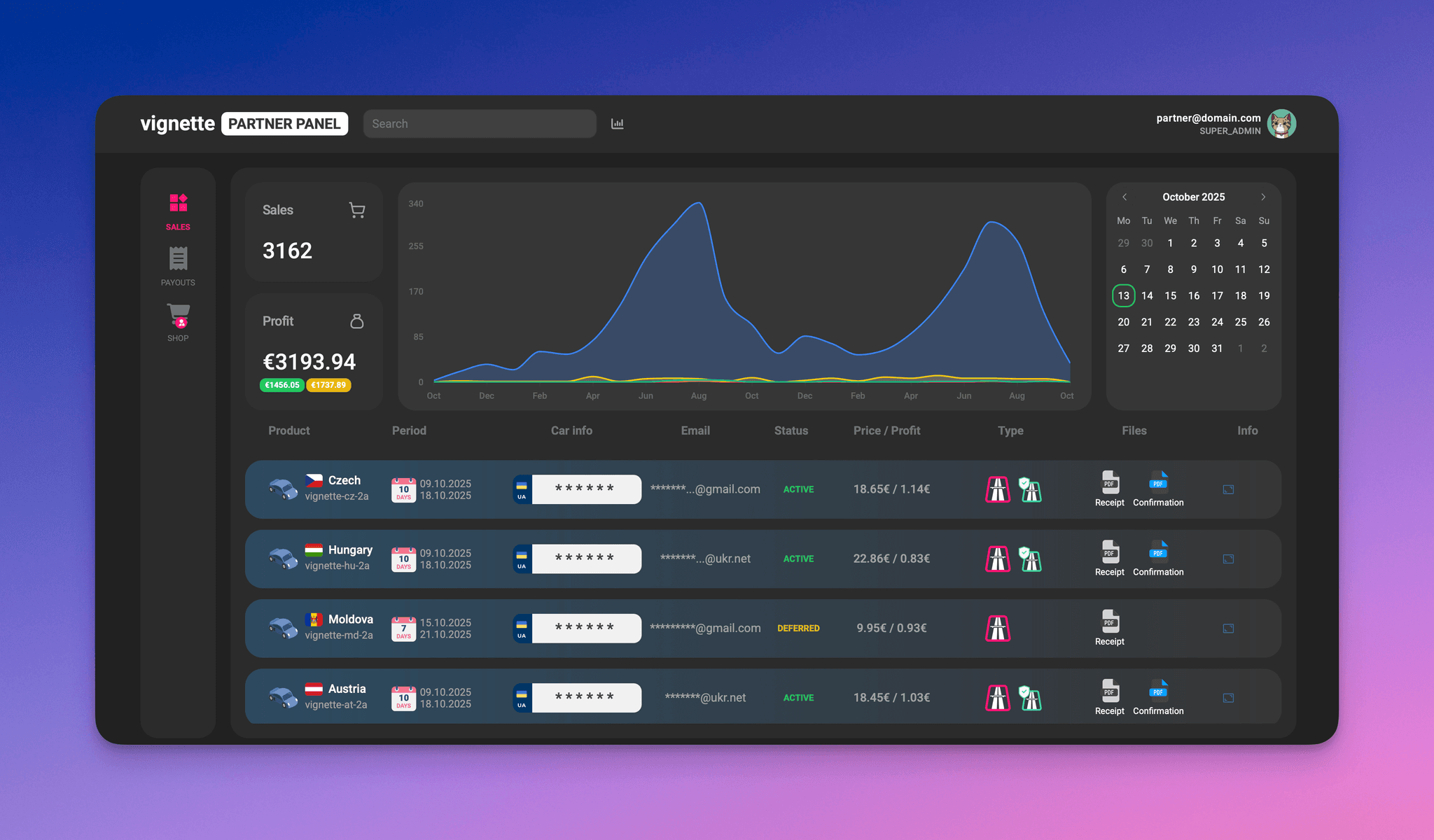
- Partner panel: a dashboard for creating and managing orders by hand, no code required. Suits agents and brokers selling case by case, and doubles as the place every partner tests and monitors orders regardless of integration.
What the API actually does
It covers the full order lifecycle, not just a product list: query the live catalogue by country, product type, vehicle type and currency, check whether a country or period is available before rendering checkout, validate a vehicle before payment, and validate a full order before committing it.
Orders placed through the API and orders already created in your own system can both be reflected in Vignette ID, the latter as external orders, keeping your records and the provider side in sync. Orders can be modified, pending or deferred orders cancelled, and a single flow can mix countries and vehicle types.
Pricing and your commission
The products endpoint returns three figures for every item: the government price set by the national provider, your partner fee, and the total price the end customer pays with your fee already included. That separation shows your margin per product, per country and per vehicle type, rather than making you reverse-engineer it from one blended number.
Prices can be requested in your own currency, including EUR, UAH, USD, PLN and HUF among others.
Commission mechanics, revenue-share terms and any deposit are set out in the cooperation agreement drawn up for your account once you register; those figures depend on your payment model and volume, so they belong in that agreement rather than in marketing copy.
Getting started
Register through the partner form to receive separate sandbox and production API keys. Log in to the partner panel to invite developers, configure your webhook and redirect URLs, and reach the revenue calculator that drafts your cooperation agreement based on the payment model you choose.
Build and test entirely against the sandbox host first: create orders, trigger webhook events, and exercise cancellations and modifications without touching real payments or real government systems. Production credentials activate once the agreement is signed. An integration call with the team is available if you want to walk through the API or iframe setup first.
Operational details worth knowing before you integrate
The product catalogue endpoint is rate-limited per partner per minute, with more headroom available as your volume grows; cache catalogue data rather than polling it for every checkout, and prefer webhooks over repeatedly polling an order's status.
Some products carry conditions checkout needs to handle: certain countries only allow a start date from tomorrow rather than today, and some require a VIN or additional driver details before the order can be created. Validating a vehicle and reading a product's restrictions before checkout avoids failed orders at payment time.
Orders move through a defined lifecycle from creation to an active, usable vignette, with distinct states for orders awaiting a provider's response, orders deferred to a future start date, and orders that end in cancellation or refund. Configure a webhook so your system updates automatically on every status change.
Who this is for
Travel agencies and tour operators adding road tolls to an existing booking flow. Insurance brokers bundling a vignette with a policy. Fleet and mobility apps covering vehicles crossing multiple countries. Car rental firms covering a customer for the rental period. Developers and system integrators who want a documented API and a sandbox rather than a manual process.