Which roads require Moldova's vinieta
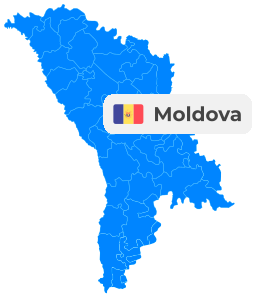
The vinieta is administered by S.A. Administrația Națională a Drumurilor (the National Road Administration, ANDS), under the Ministry of Infrastructure and Regional Development, through the official e-Vinieta system at evinieta.gov.md. It applies to every vehicle that is not registered in the Republic of Moldova and is required on all public roads in the country, not only on the busiest national routes, for as long as the vehicle is on Moldovan territory.
Vehicles registered in Moldova do not buy a vinieta. Their owners instead pay a separate annual road tax collected by the State Fiscal Service and linked to the periodic technical inspection, so the two charges never apply to the same vehicle at the same time.
A small number of vehicles are exempt, including those used by diplomatic missions and consular offices, foreign-registered vehicles covered by international road transport authorisations, and vehicles temporarily imported by returning residents under specific customs regimes.
Vehicle categories and validity periods
The charge is set by vehicle type. Passenger cars and their trailers fall under tariff category 8703, the category most drivers need; separate categories cover buses with 9 to 24 seats, buses with more than 25 seats, and trucks or tractor units grouped by maximum authorised mass, with the rate doubled for vehicles carrying dangerous goods.
Moldova's tax legislation sets the vinieta in fixed blocks rather than by the day, and for cars the periods available here run from 7 days up to 180 days: 7, 15, 30, 90 and 180 days. Rates are fixed in euros regardless of the currency you pay with; see the price table above for the current options.
- Cars and their trailers (tariff category 8703)
- Buses with 9 to 24 seats
- Buses with more than 25 seats
- Trucks and tractor units up to 3.5 tonnes
- Trucks and tractor units from 3.5 to 10 tonnes
- Trucks and tractor units from 10 to 40 tonnes
Buying and activating the vinieta
The Moldova vinieta is fully electronic and is registered against your licence plate, so there is no sticker to display on the windscreen. Buy it online before you set off or right up to the moment you cross the border and choose the start date yourself: Moldova gives no grace period after entry, so the vinieta must already be valid once you are on Moldovan territory.
Moldova asks for more than the plate: an order needs the vehicle's VIN (chassis number) and the driver's details as well, so keep the registration document and the driver's passport or licence to hand before you start. Enter the plate using Latin letters only, without spaces or hyphens, since Cyrillic characters are not accepted and a mismatched plate can make the vinieta invalid at a roadside check.
With Vignette ID, the vinieta is delivered by e-mail and kept in your account, normally within a few minutes of your payment being confirmed; you can pay by card, Apple Pay or Google Pay, and no account is required to buy. A Flex add-on lets you update the registered plate after purchase for a fee if your vehicle or travel plans change.
Fines and enforcement
Vinieta validity is checked by border police and customs officers at Moldova's border crossing points, who compare the plate on your vehicle against the e-Vinieta database. Driving without a valid vinieta is a contravention under Moldova's Contravention Code and carries a fine of 2,250 to 9,000 Moldovan lei, with repeat offences in the same year penalised more heavily.
Paying the fine does not remove the underlying obligation: you must still buy a vinieta covering the period the vehicle was on Moldovan roads. If you realise you forgot to buy one, do it online as soon as possible rather than waiting until you leave the country.
Tolls not covered by the vinieta
Moldova does not operate separate section tolls, tunnel charges or bridge tolls of the kind found in some neighbouring countries. The vinieta for foreign-registered vehicles and the annual road tax for Moldovan-registered vehicles are the only nationwide charges for using the public road network, so a valid vinieta is not followed by a toll booth further along the route.
Good to know for foreign drivers
Most vinieta buyers arrive with EU-registered or Ukrainian-registered vehicles, either transiting Moldova or visiting for a short stay, and both groups need the same vinieta. Specific rules have applied at times to vehicles entering or transiting from Ukraine, so check the current requirement before you travel if you are crossing that border.
Keep your payment confirmation accessible on your phone, since it is the document a border officer or police patrol will ask to see if your plate cannot be matched electronically.